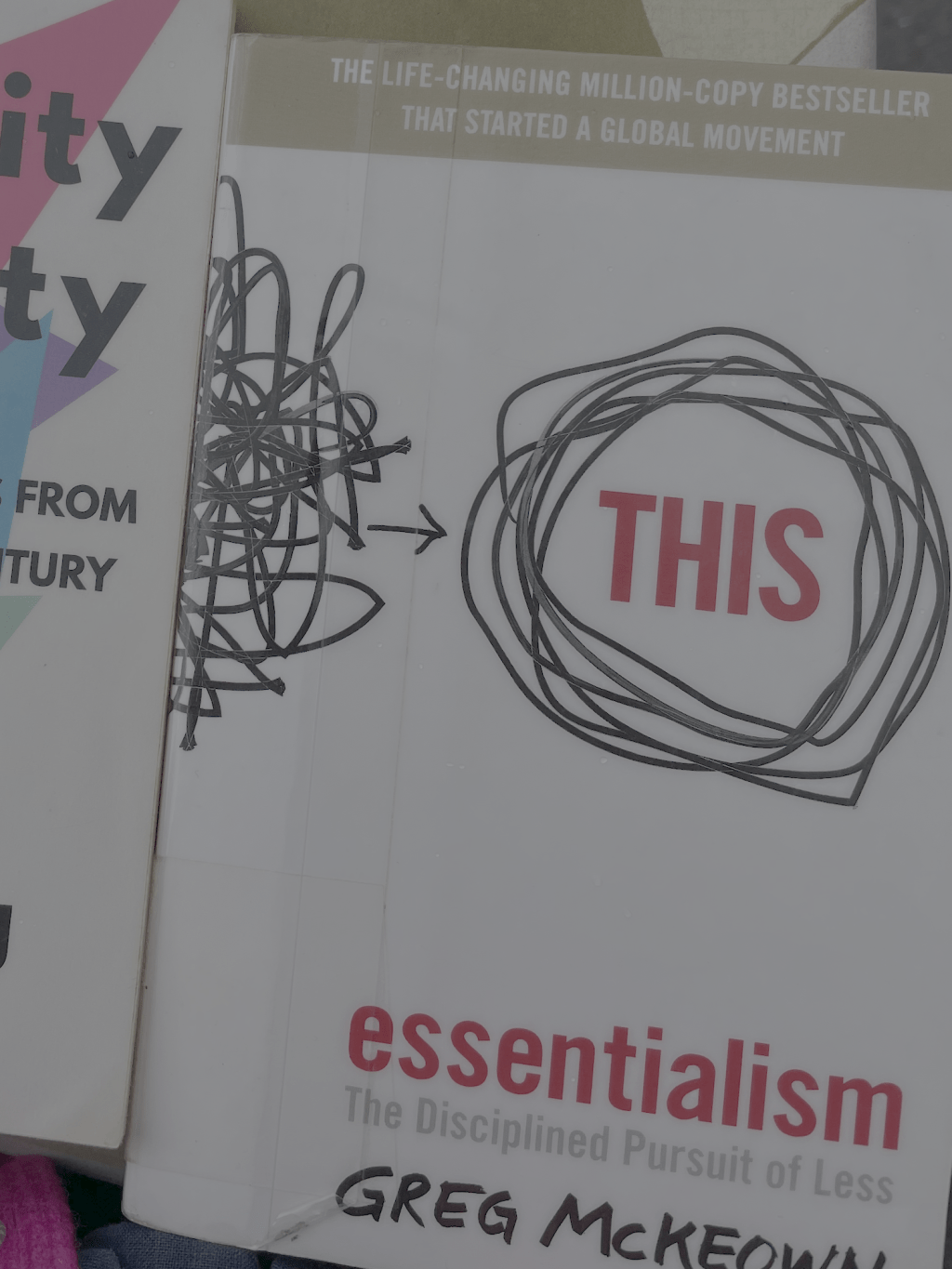
It has been clarifying and refreshing to read Essentialism – The Disciplined Pursuit of Less, by Greg McKeown. Many enthusiastic nods from my direction as I’ve made my way through the book.
Essentialism is what I’d like more of. Greg best describes the concept and the book on his website:
The Way of the Essentialist involves doing less, but better, so you can make the highest possible contribution.
The Way of the Essentialist isn’t about getting more done in less time. It’s not about getting less done. It’s about getting only the right things done. It’s about challenging the core assumption of ‘we can have it all’ and ‘I have to do everything’ and replacing it with the pursuit of ‘the right thing, in the right way, at the right time’. It’s about regaining control of our own choices about where to spend our time and energies instead of giving others implicit permission to choose for us.
In Essentialism, Greg McKeown draws on experience and insight from working with the leaders of the most innovative companies in the world to show how to achieve the disciplined pursuit of less.
By applying a more selective criteria for what is essential, the pursuit of less allows us to regain control of our own choices so we can channel our time, energy and effort into making the highest possible contribution toward the goals and activities that matter.
I’ve been trying to do this, to figure out how to live this way, and be intentional about it. I thought it was me being lazy at first, by wanting to be very focused, to “do less”, to prioritise what I wanted to prioritise. But actually no, I’m just being realistic?? We humans are not superhuman. We have limited energy, time, focus and motivation. Our health and lifespans are not guaranteed. In fact, it can be seen as a privilege to be alive and without any health issues.
How could I live life to the fullest, but also, even if I wanted to, recognise that I can’t do every single possible thing that comes to mind, and help every single person or good initiative in this world. Lofty aspirations, but unrealistic! Essentialism helps to clarify that…
Essentialism isn’t one more thing; it is a different way of doing everything. It is a discipline you apply constantly, effortlessly. Essentialism is a mindset; a way of life. It is an idea whose time has come.
If this sounds like something that interests you, I’d encourage you to read it. It’s very practical. You will be able to apply things to life – if you dare to make the changes.
Julie Hood, a coach and advisor for me for a season, recommended I read this nearly five years ago. I’ve only managed to borrow the book from Wellington City Library now?! But, the book looks to be one that I’d like to see on my shelf long term. A keeper!
The Psychology of Busy
I first discovered Julie in October 2020, as a management & governance advisor and coach. She hosted a webinar The Psychology of Busy: when it’s good, when it’s not, and how to close the gap. It was eye opening at the time and helped me in a pragmatic way. I wanted leadership of my time and wanted to my team to have it too. But a confession: I’ve not yet achieved an inbox with zero emails sitting there, both professionally and personally – a high target she set for me!
Her webinar included discussion on:
- The Eisenhower Matrix (Do, Delegate, Schedule, Eliminate – based on importance and urgency). James Clear has a good post on this too: How to be More Productive and Eliminate Time Wasting Activities by Using the “Eisenhower Box”. A good example of Eliminate is to stop watching TV. Thanks to my Mum setting the standard/example, I have never really watched TV as an adult to relax or formed a habit of using it to pass time. You can do so much instead of watching TV! But I also don’t have much to talk about if people are discussing the latest series.
- Moving from working reactively to proactively where possible
- Learning about how to have better impact (Imploding > Intentional > In Action > Inspiring) over time (Wake Up > Stand Up > Lift Up > Look Up), whilst looking after well-being.
The Power of a Positive No
Julie also recommended me the book, The Power of a Positive No: How to Say No and Still Get to Yes. It’s written by William Ury, American author, academic, anthropologist, and negotiation expert. The material is based on William’s successful Harvard University course for managers and professionals. It’s another book on my “to read” list, but this four-minute video sums up the main point:
Takeaways: Behind every yes lies a thousand no’s!
- The art of leadership is more about saying no. To get to the right yes, you have to say no.
- No is critical to get to the right yes, in business and life.
- A positive no = yes no yes sandwich.
Do you think this concept and book would be interesting to you too?
Crazy, geeky idea – would these two books be good for a social book group?!
 Lì Líng Ho